SEO used to be easy to explain. You ranked well, people clicked, traffic increased. Over time, you refined what worked and doubled down. While that model still exists, it no longer reflects how many people use search.
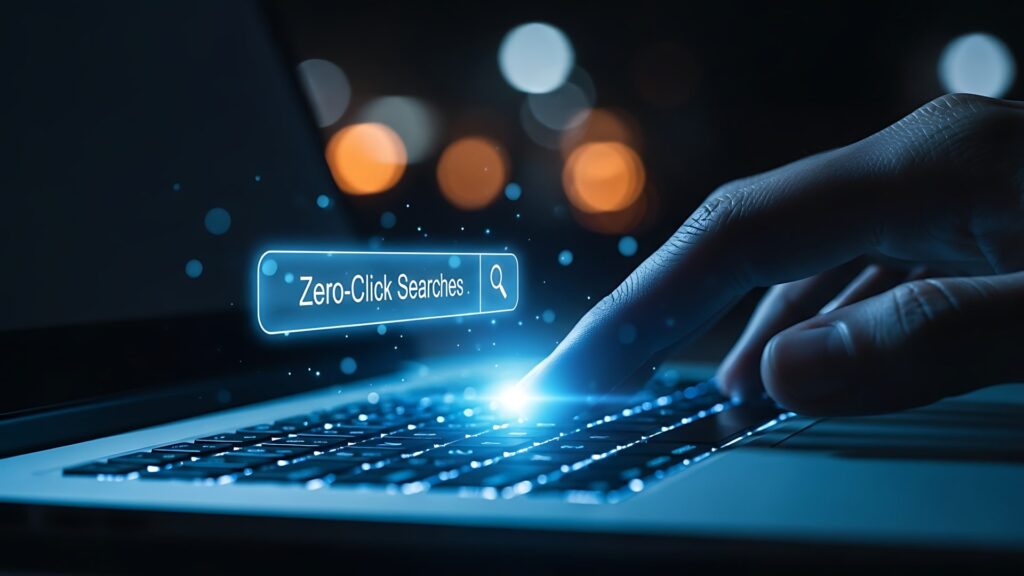
Today, a growing number of users get what they need directly from Google’s results page and move on without visiting a website. No click, no session, no obvious signal that your content played a role at all.These interactions are known as zero-click searches, and although they often cause frustration, they are better viewed as a change in behaviour rather than a failure of SEO.
What Are Zero-Click Searches?
Zero-click searches are essentially increasing but also potentially damaging to those who are specifically trying to grow but are not summarising seamlessly or winning visibility.
These kinds of searches are becoming more common as users find what they need through Google’s surfacing of information through featured snippets, knowledge panels, local maps results, or People Also Ask boxes.
This is especially common for informational queries and mobile searches, where speed matters more than depth. According to analysis from Ahrefs, Google’s expanding use of SERP features has led to a noticeable rise in searches that end without a user clicking through, mainly where intent can be satisfied quickly.
For brands, this means visibility does not always translate into traffic, but it still carries value. Being present, clearly, and consistently, is now part of the outcome.
Why Zero-Click Searches Are Increasing
Google’s priorities offer a clear explanation, with a devoted focus to reducing friction and delivering only the most relevant answer instantly.
This approach is reflected in Google’s own documentation on featured snippets and search result appearance, where clarity and usefulness are consistently emphasised.
Search behaviour has also changed. Many queries today are short, functional, and often voice-led. People are not always looking to research. Sometimes they simply want confirmation, a definition, or a quick answer. In those cases, a full article is unnecessary.
At the same time, Google has become far better at understanding intent. It can usually determine whether a search requires depth or a brief response, and when it is confident, it keeps the user on the SERP.
Why Visibility Still Matters Without the Click
It is tempting to see zero-click searches as lost opportunities, but that view focuses too narrowly on immediate traffic.
When people keep seeing a brand pop up in featured snippets or other knowledge panels, it starts to feel familiar, even if they don’t click right away. That repeated visibility helps them connect the brand with the topic, and over time, that familiarity turns into trust. Later, when they’re searching with a clearer intent to buy or compare options, that trust often nudges them toward the brand they’ve already “seen around.”
In that way, zero‑click visibility isn’t wasted. It plays an early but important role in the customer journey by putting your brand in front of people before they’re even ready to engage. It is less about conversion and more about presence.
How Brands Can Still Win Visibility
Clarity is one of the biggest differentiators in a zero-click environment. Content that answers questions directly, uses clear structure, and avoids unnecessary padding is far more likely to be surfaced by Google. Research from Sistrix shows that featured snippets are often awarded to pages that explain things more clearly than competitors, not those that are simply longer.
Brand strength also plays a growing role. Zero-click behaviour affects generic searches far more than branded ones. When users search for a company by name, they usually intend to visit the site. Investing in brand visibility through content, PR, and consistent messaging therefore helps protect organic performance over time.
This idea is reinforced by guidance from HubSpot, which highlights how sustained brand exposure increases recognition, trust, and future buying decisions, even when engagement is not immediate.
It also helps to think of the results page itself as a branding surface. Meta titles, descriptions, and naming conventions need to communicate credibility quickly. Even without a click, a strong SERP presence increases the likelihood that users will return when their intent changes.
Depth still matters too. If a page can be summarised in a single sentence, Google will often do that itself. Content that includes real insight, experience, or original thinking is much harder to replace. Case studies, expert commentary, and in-depth guides continue to earn authority, links, and long-term visibility.
A New Angle: Measuring SEO
Traditional SEO metrics need more context as zero-click searches become more common. Clicks do truly matter but they are not the be all and end all of the story.
Impressions, branded search growth, repeat visibility, and assisted conversions give a clearer picture of how SEO actually supports the wider marketing journey. The value of SEO becomes more pronounced even if a conversion to clicks is not completely guaranteed. Therefore, instead of simply pouring all of your energy into clicks, it’s important to create content that helps users to discover and engage with your brand over time. Specifically pointed out by The Content Marketing Institute, both influence and visibility should be measured in addition to traffic. This is incredibly important now that content, SEO, and brand strategy is so crucial.
Final Thoughts
Zero-click searches are not a threat to SEO. They reflect how people search today and how Google chooses to respond.
Brands that focus only on traffic risk missing how trust, authority, and awareness are built directly on the results page. Those that adapt, and treat visibility as valuable, are far better placed to succeed.
SEO has not disappeared. It has simply moved closer to the searcher.