
From past success of guest blogging, we are aware that there are lots of


Over the coming weeks, we are going to be bringing you the Ultimate Guide to Guesting Posting, and giving you an insight into aspects of guesting posting like:
Guest posts or, guest blogs are content published in the form of an article on someone else’s website. It really is that simple and it can be a key tool to growing your business and online presence!
Guest blogging is a content marketing tactic that involves writing content to publish on an existing website and include links back to your own website. Depending on where you publish your article, there will be different requirements as to what is accepted, including whether the post is tagged to say who it was written by, the amount of words and links that can be included in the article and whether it remains on the site permanently. These are all important things to check before making a guest post on a website.
A guest post can not only help marketing based roles, but any company wishing to boost its online presence, promote a product or process or reach new audiences.
[article_advert]
Within the guest posting world, there are site providers who have sites readily available to publish your content, and then the opposite, those looking for somewhere to post their content. It is a mutually beneficially exchange between the two sides and ensuring you find the correct match for your content; it can be very successful. The guest posting process is all about finding either the right content to match your site, or the right site to match your content! It is a positive element to add good quality content to your own website, or vice versa, to publish on a good quality website to build your brand awareness. With many guest post transactions there can be a money exchange and this will also need to be discussed between the two parties involved, before making your post.
During the upcoming articles in our Ultimate Guide to Guest posting, we will be delving into the actual benefits but here is a quick diagram from SEOCZAR of the 10 most beneficial elements…
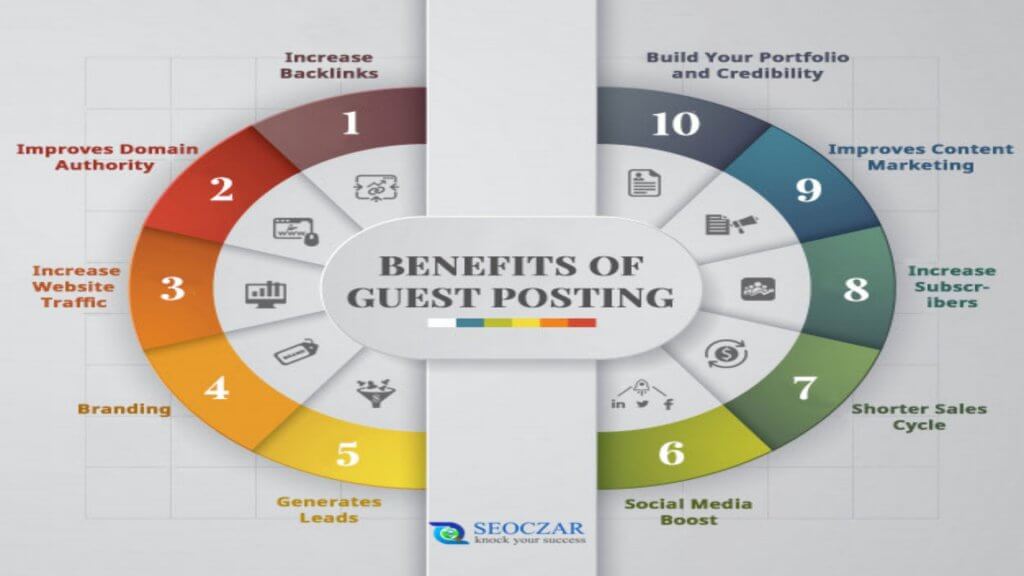
To adopt this marketing tools within your own work through the form of guest posts, there are many platforms available that allow you to process a guest post on their sites and some contain multiple domains to choose from. Platform with multiple domains, do some of the hard work for you and make it easy to find somewhere suitable for your content and ensure that you will get the best results from guest posting.
Look out for the next article where we will be sharing more information on our own guest post site, BubbleSEO and other platforms.
Grow your business online with content marketing solutions from Bubble SEO today.
Place An Order
From past success of guest blogging, we are aware that there are lots of

Blogging and guest posts can enhance authority, and build relationships

When you are running a small business, time is always in short supply. But that does not mean your blog content should be left untouched. With just 20 minutes, you can update an existing post and give it a powerful SEO lift. Whether your goal is to attract more organic traffic, improve engagement, or increase conversions, this quick checklist will help your content work harder for your business. 1. Start with a Smart Keyword Check Start by checking if your target keyword is still relevant. Search habits and trends evolve quickly, and what worked six months ago may no longer perform well. Use a quick Google search to review how competitive your target phrase is and see which competitors are currently ranking. You can also use free tools like Ubersuggest or Google Trends to assess search volume and interest over time. Make sure your main keyword appears naturally in the title, within the first 100 words, and in at least one subheading. The key word here is "naturally." Avoid keyword stuffing, which can harm your rankings and diminish readability. 2. Refine Your Title Tag and Meta Description Your blog title may be engaging, but do not forget to check your metadata. The title tag and meta description help search engines understand your content and encourage users to click. Keep your title tag under 60 characters and include your primary keyword. Write a clear, benefit-driven meta description under 160 characters. Your meta description should accurately reflect the content and provide a reason to click. This also appears in search results and can affect your click-through rate. For best practice, refer to Google’s SEO Starter Guide. 3. Use Clear and Consistent Subheadings Subheadings improve readability and help search engines understand the structure of your content. Use H2 and H3 tags to break up your text and guide the reader through your message. Make sure your subheadings reflect your main themes and, where appropriate, include relevant keywords. This not only improves SEO but also makes your content more digestible for busy readers, especially those in fast-paced SME environments. 4. Add Internal Links Strategically Internal linking helps Google crawl your site more effectively and keeps visitors engaged for longer. Link to other relevant blog posts, service pages, or contact forms within your own site. Use descriptive anchor text. Instead of writing "click here," try "learn more about our SEO services" or "visit our contact page." This reinforces relevance and provides a better user experience. You can see a great example of this strategy on the Moz Beginner's Guide to SEO. 5. Optimise Image Sizes and Alt Text Slow-loading images can negatively affect both user experience and rankings. Use compressed image formats like WebP or JPEG and limit file sizes without sacrificing quality. Free tools like TinyPNG or Squoosh can help reduce image weight without a visible drop in resolution. In addition to compression, always add descriptive alt text. This helps with accessibility and provides another opportunity to include relevant keywords. 6. Format for Mobile and Readability Before you hit publish, check that your post looks good on mobile. Google prioritises mobile-first indexing, so a mobile-friendly layout is essential. Use short paragraphs, bullet points, and plenty of white space to improve legibility. Test how it looks on both mobile and desktop to make sure formatting is consistent and easy to scan. 7. Hit Publish and Promote It Once your blog is optimised, go ahead and publish it. If it is an older post, consider updating the published date so it reflects the fresh edits. After publishing, promote your post through your usual marketing channels. This could include sharing it on LinkedIn, featuring it in your email newsletter, or repurposing parts into social media content. At BubbleSEO, we always recommend repurposing content into formats your audience prefers to consume. Final Thoughts Optimising a blog post does not have to be a time-consuming task. With just 20 minutes and a focused checklist, you can improve your post’s visibility, usability and impact. This process is especially valuable for small businesses that need to make the most of every piece of content. Bookmark this guide, refer back when refreshing old posts, and let your content continue to support your business goals.

AI has come a long way in recent years, weaving its way into our daily lives in ways we never imagined. Whether it’s curating playlists, drafting emails, or generating content for businesses, AI is proving to be an incredibly powerful tool. But with all its benefits, there’s an ongoing debate: Are we sacrificing human creativity and authenticity in the process? Let’s take a closer look at how AI-generated content stacks up against human writing. The Pros of AI-Generated Content Speed & Efficiency: AI’s Biggest Strength Picture this: You’ve got just two hours before a blog post needs to go live, and you still need to write social media captions to go with it. You’re swamped. Instead of scrambling, you turn to AI-powered tools like ChatGPT, which can generate the content in minutes—optimized for SEO and free of grammatical errors. For businesses, AI is a game-changer when it comes to time management. According to McKinsey & Company, generative AI can automate up to 70% of repetitive content creation tasks, freeing up time for more strategic work. Cost Savings: AI as an Affordable Alternative AI doesn’t just save time—it saves money. Businesses that previously relied on hiring full-time writers or outsourcing content creation are now turning to AI to generate large volumes of content at a fraction of the cost. A PwC study estimates that AI-driven automation could add $15.7 trillion to the global economy by 2030, largely due to increased productivity and cost savings. With AI’s ability to churn out multiple articles in a short time, it’s easy to see why companies are adopting it as a budget-friendly content solution. However, while AI is efficient and cost-effective, it’s not without its drawbacks. The Cons of AI-Generated Content Creativity & Originality: Can AI Compete with Humans? While AI is fast and efficient, it struggles to match the creativity of human writers. AI can process vast amounts of data, but it lacks the ability to truly innovate, draw from personal experiences, or be inspired by the world in the way humans can. A study by Harvard Business Review highlights that while AI can generate creative outputs, it doesn’t produce truly novel ideas—it simply remixes existing ones. Another issue is content overlap. Since AI pulls from its training data, there’s a chance of repeated or recycled ideas, which can raise originality concerns. Even Google’s Search Central Blog warns that AI-generated content must be “helpful, original, and high-quality” to rank well in search results. SEO & Quality Risks: The Potential Downside of AI Content AI-generated content might be SEO-friendly, but that doesn’t mean it’s always effective. Search engines prioritize valuable, engaging, and human-like content—and mass-produced AI content doesn’t always meet these standards. According to SEMrush, while there’s no official Google penalty for AI-written content, sites relying too heavily on it could suffer in search rankings. Google’s algorithm favors content that demonstrates expertise, experience, authority, and trustworthiness (E-E-A-T), and AI lacks real-world experience—something human writers naturally bring to the table. For businesses that rely on SEO to drive traffic, overusing AI could actually do more harm than good. Finding the Right Balance AI is an incredible tool, but it works best when paired with human creativity. While it excels at speed, efficiency, and cost-cutting, it falls short when it comes to originality, emotional depth, and authentic storytelling. At Bubble SEO, we understand the value of human-written content. That’s why every piece we create is crafted by our expert team, led by Sofi Parry, ensuring your content aligns with your brand’s goals while maintaining a unique and personal touch. Want high-quality, human-crafted content for your business? Get in touch with Bubble SEO today!

Introduction: The Great Debate It’s a common misconception that SEO and social media work against each other. The opposite is true. If a business can master the relationship between social media and SEO, it can significantly boost brand awareness, drive more traffic, and reach new audiences. Let’s explore how these two powerful tools can complement each other. 1. Social Signals: Do They Directly Affect SEO? In 2015, Google’s John Mueller confirmed that social signals (likes, comments, and shares) are not a direct ranking factor in Google's search algorithm. However, they still play an indirect role in SEO. When your content performs well on social media, it can build your brand’s reputation, drive more people to search for your business directly, and ultimately enhance your organic search presence. 2. Driving Traffic with Social Sharing Social sharing involves distributing your website content across your social media platforms. For example, when a new blog post is published, many companies promote it via an Instagram or LinkedIn post. Benefits of social sharing include: Enhanced visibility and reach Increased user engagement and trust Potential for backlink generation (critical for SEO success) While the impact on SEO is indirect, greater visibility and backlinks from shared content can improve your site's performance on Search Engine Results Pages (SERPs). 3. Boosting Link Opportunities Through Social Media It’s tempting to assume that a viral post automatically improves SEO—but that's not guaranteed. When posts go viral, they sometimes get picked up by reputable sources like news outlets or high-authority blogs, creating valuable backlinks that do influence SEO rankings positively. However, if your viral content is mostly shared by small sites with low domain authority, the SEO benefit will be limited. Plus, viral traffic tends to be short-lived—once interest fades, any SEO boost may also decline unless sustainable strategies are in place. 4. Consistency in Branding & Messaging Maintaining a consistent brand voice across all channels is essential for building strong brand recognition. Social media and SEO together offer a powerful way to ensure your messaging remains unified. For example: If you publish a new blog on Monday, you could promote it via social posts throughout the week. Alternatively, you can repurpose content, highlighting key messages in your social posts and linking back to the blog. This reinforces your brand message, helping customers associate your social media activity and website content as part of one cohesive identity. 5. Influencers & UGC: Hidden SEO Benefits Influencer marketing and user-generated content (UGC) can also impact SEO. UGC—like product reviews, social media shoutouts, and unboxing videos—provides authentic, trustworthy content that resonates with audiences. It can also target long-tail keywords and answer specific user queries, improving your website’s relevance and authority in search results. Encouraging customers and influencers to share their experiences not only boosts trust but can also improve your organic visibility. Conclusion: Two Strategies, One Goal Although social media activity doesn’t directly affect SEO rankings, the indirect benefits are undeniable. Social sharing, brand awareness, backlink opportunities, and UGC all contribute to strengthening your online presence. Rather than seeing SEO and social media as separate or competing strategies, businesses should aim to integrate them wherever possible. Together, they are a powerful combination for growing your brand, expanding your audience, and driving long-term success.

Every so often, a client asks us how many blogs they should be publishing each month. I understand why. Everyone wants a number. One blog? Four? Ten? The frustrating answer is that SEO doesn't really work like that. If there was a guaranteed publishing formula, we'd all be following it. The reality is that I've seen websites post new content almost every day and struggle to gain any momentum. I've also seen businesses publish once or twice a month and steadily increase their organic traffic over time. That isn't because Google prefers one approach over the other. Usually, it comes down to whether the content is worth reading. Unfortunately, there is usually a temptation to chase volume as there seems to be a belief in digital marketing that more content automatically leads to better rankings. At first glance, that makes perfect sense. More articles create more opportunities to rank for keywords. More rankings can lead to more traffic. More traffic should create more enquiries. The problem is that content isn't produced in a vacuum. Every article takes time to research, write, edit and publish. The more content you create, the harder it becomes to maintain quality. Sooner or later, many businesses find themselves writing blogs simply because the calendar says they need to. Readers notice that, and search engines do too. Google has spent years improving its ability to identify useful content. Its advice consistently revolves around creating pages that help people rather than content designed primarily for search engines. The guidance available through Google Search Central makes that fairly clear. That's one reason why publishing frequency, on its own, isn't a particularly useful SEO metric. What actually works? In our experience, consistency tends to outperform intensity. A business that publishes two genuinely helpful articles every month for a year will often achieve better results than a company that publishes twenty articles in January before losing enthusiasm altogether. Someone starts a new content strategy full of good intentions. The first month is productive, the second month slows down, but then, by month three, the blog section resembles an abandoned New Year's resolution. The businesses that see results are usually the ones taking a more sustainable approach. They're not trying to dominate search overnight, they're simply showing up regularly. In actual fact, most businesses don't actually need daily content. This is probably where some marketers will disagree, but most companies simply don't need to publish articles every day. For a local service business, a specialist consultancy, or a growing e-commerce brand, one well-written blog each week is often more than enough. Some businesses may only need two strong articles a month. The key word here is "strong". A thoughtful article that answers real customer questions can continue attracting traffic for months or even years. That's very different from publishing large amounts of content that quickly become irrelevant. Research discussed by platforms like Ahrefs and Semrush regularly points towards the same conclusion: quality, relevance and authority matter. None of those things are measured by how many blogs were published last Tuesday. However, there's another side to this conversation. Whenever people discuss content frequency, they usually focus on new content but, oddly enough, some of the best SEO gains come from content you already have. A blog written two years ago might contain outdated statistics, broken links, or sections that no longer reflect current search behaviour, and updating that article can sometimes deliver far more value than creating something entirely new. We've all been guilty of overlooking old content because writing something fresh feels more productive. In reality, a carefully refreshed article can be surprisingly effective. The team at Moz have spoken about the importance of maintaining content over time, and it makes sense. Search engines want to direct users towards information that's accurate and still relevant. Content isn't the whole story This is another point that often gets lost. Publishing content is important, but content alone rarely carries an SEO strategy. An excellent article still benefits from internal links, backlinks, and promotion. Without visibility, even great content can struggle to reach its full potential. That's why many businesses combine content marketing with activities such as guest posting, digital PR, and authority-building campaigns. At Bubble SEO, we often see stronger results when businesses stop viewing content and link building as separate activities. They work best when they support one another. How often should you publish? The honest answer is probably less exciting than you were hoping for: publish as often as you can comfortably maintain without compromising quality. For some businesses that's one article every month, for others it's one every week, but neither approach is automatically right or wrong. What matters is that the content serves a purpose, helps your audience, and forms part of a long-term strategy rather than a short burst of activity. SEO is full of shortcuts that promise quick results, and consistently publishing useful content isn't one of them. Solid SEO results take patience and, thankfully, patience has a habit of paying off.

How to find guest posting platforms?

Building high-quality backlinks remains one of the most effective ways to improve your website’s search engine rankings and drive organic traffic. But with ever-evolving algorithms, it’s crucial to adopt strategies that are not only effective but also align with Google’s link-building guidelines. This complete guide breaks down proven link-building strategies that can help your business achieve sustainable growth online. Why Is Link Building Important? Links act as "votes of confidence" for your website. Search engines like Google evaluate these links to determine the authority, relevance, and trustworthiness of your content. A well-executed link-building strategy can: Improve SEO rankings: High-quality backlinks signal credibility to search engines. Increase referral traffic: Links on relevant sites can bring in targeted visitors. Enhance brand visibility: Backlinks expose your brand to wider audiences. 1. Create High-Quality Content Exceptional content is the foundation of any successful link-building campaign. Content that provides value—whether it’s in-depth guides, videos, or infographics—naturally attracts links.Consider investing in data-driven studies, industry reports, or step-by-step tutorials that solve your audience's pain points. Actionable Tip: Use tools like Google Trends and Google Keyword Planner to identify trending topics relevant to your niche. 2. Guest Posting Guest posting remains a staple for link building. By contributing articles to reputable websites within your industry, you not only earn backlinks but also establish yourself as a thought leader.At Bubble SEO, we specialize in crafting engaging guest posts that align with the host site’s audience and guidelines. How to Get Started: Research blogs in your niche using platforms like BuzzSumo or Ahrefs Content Explorer. Pitch topics that add value to their readers while subtly promoting your expertise. 3. Broken Link Building This strategy involves finding broken links on other websites and suggesting your content as a replacement. Not only do you help the site owner fix their links, but you also gain a valuable backlink. Steps: Identify broken links using tools like Check My Links or Ahrefs Broken Link Checker. Reach out to the website owner with a polite email, offering your content as an alternative. 4. Leverage Social Media and Influencers Social media platforms and influencer partnerships can amplify your link-building efforts. While links from platforms like Twitter or LinkedIn are usually no-follow, they drive traffic and encourage natural link generation.Collaborating with influencers can also boost your content’s visibility to a wider, engaged audience. Example: Work with influencers to share your high-value resources, increasing the likelihood of backlinks from their followers' websites. 5. Local Citations and Directories For local businesses, getting listed on relevant directories is an easy win. Ensure your business is added to: Google My Business Yell Trustpilot These citations often come with backlinks and improve your local SEO rankings. 6. Competitor Backlink Analysis Understanding where your competitors get their backlinks can uncover new opportunities. Tools like SEMrush and Ahrefs allow you to analyze their backlink profiles and replicate successful strategies. 7. Participate in Community Forums and Q&A Platforms Contributing to platforms like Quora, Reddit, and niche-specific forums can help you gain backlinks. Focus on providing genuine value rather than spamming links. Conclusion Effective link-building requires a combination of creativity, persistence, and strategy. By focusing on quality over quantity and adopting a diverse range of tactics, you can build a robust backlink profile that drives real results. To learn more about professional link-building services or to discuss a bespoke SEO strategy for your business, visit BubbleSEO. Let’s build better links for a brighter online future!
We're excited to announce that AI Guest Posts has undergone a transformative rebranding and is now known as Bubble SEO. This strategic move has allowed the business to develop within the digital landscape and highlight our commitment to providing digital marketing solutions tailored to enhance online visibility and engagement for our customers. Bubble SEO remains dedicated to delivering high-quality, targeted content and effective SEO solutions that align with evolving digital marketing trends. Here is a little more information about our brand and its services. Our services: At Bubble SEO, we specialise in three core services, with content writing being a new feature to the website: Guest Posting: Which aims to enhance your online presence with high-quality guest posts on authoritative websites, driving traffic and boosting your SEO rankings. Link Building: Helps build a robust backlink profile with strategic link building services that improve your website's authority and visibility. Content Writing: Provides engaging content for your audience with compelling content tailored to your brand voice and SEO needs. Benefits of Bubble SEO: We have now made changes to the booking process to simplify this, and updated the customer dashboard section in the hope to improve our existing values below: Enhanced Service Quality: With our rebranding comes a renewed focus on delivering top-notch services that exceed your expectations. Improved User Experience: Our new website offers a streamlined interface, making it easier for you to navigate and access our services. Expanded Network: Benefit from our expanded network of partner websites, ensuring broader outreach and better opportunities for your business. Loyalty Rewards: As a token of our appreciation for the continued support of our bookers, we have now introduced loyalty rewards: Exclusive Discounts: Enjoy special discounts as a loyal Bubble SEO customer, with the more points you acquire, the more exciting offers you will unlock. We're thrilled about this new chapter as Bubble SEO and look forward to continuing to be your trusted partner in achieving your digital marketing goals. Stay tuned for more exciting updates and announcements! Discover the new Bubble SEO and elevate your online presence today! Jennifer Hobson – Digital Marketing [email protected] Heather Ryan – Business Development [email protected]

If you work in digital marketing long enough, you see the same pattern repeat. A business invests heavily in SEO, ticks every technical box, and still struggles to grow. Another pours time into content, publishes regularly, and wonders why traffic never really arrives. Both usually assume they are missing a trick. In reality, they are missing each other. SEO and content marketing have never been separate in practice, even though they are often treated that way. One shapes how your site is understood. The other shapes how it is experienced. You need both, because search engines and people care about different things, and your website has to satisfy them at the same time. Traditional SEO is still the starting point. Pages need to load properly, internal links need to make sense, and keywords still matter. Search engines cannot rank what they cannot understand. Semrush’s breakdown of what SEO actually involves makes that fairly clear. Structure and clarity come before anything else. But this is where many strategies stop. Pages are optimised, metadata is polished, and then nothing else really happens. Traffic might rise briefly, but it often flattens out. When it does, the instinct is to tweak keywords again or chase more links. The problem is rarely the setup. It is what happens once someone arrives. This is where content marketing earns its place. Not as a buzzword, and not as a volume exercise, but as the part of the strategy that gives your site weight. Content is what turns a technically sound page into something people actually want to read. Good content does not feel like it was written to rank. It feels like it was written because someone understood the question being asked. Google has been nudging things in this direction for years, and platforms like Think with Google regularly reinforce how much expectations have changed. People are quicker to leave, quicker to judge, and far less patient with vague answers. SEO-only pages tend to struggle here. They match the query, but not the intent. They say just enough to exist, but not enough to be useful. Backlinko’s research into Google ranking factors shows how closely performance is tied to engagement and relevance. Those signals are difficult to fake without substance. At the same time, content marketing on its own has limits. Publishing thoughtful articles without any search consideration often leads to frustration. The content is fine, sometimes very good, but it never quite finds an audience. SEO adds direction. It shows what people are actively looking for and how competitive that space is. Ahrefs explains this well in its guide to SEO-driven content creation, where content ideas come from demand rather than instinct. This does not make content robotic. It simply stops it from being invisible. When the two approaches are planned together, things change. Content starts answering real questions, not imagined ones. SEO becomes less about forcing pages to rank and more about supporting the content that deserves to be seen. This is also where link building becomes easier. People link to things that help them. The Content Marketing Institute has written about how content-led strategies support link building more naturally than outreach-heavy tactics. In practice, this is obvious. A useful resource travels further than a perfectly optimised page ever will. Trust plays a bigger role here than most strategies acknowledge. Sites that publish consistently helpful content tend to weather algorithm changes better. They feel less brittle. SEO gets them noticed. Content keeps them credible. Semrush touches on this balance in its guidance around SEO content strategy, but it is something you usually see more clearly in real-world results than in reports. Sites that combine structure with substance tend to grow steadily. Sites that lean too hard on one side rarely do. There is no real debate between content marketing and traditional SEO. They are not alternatives. They are different parts of the same process. SEO helps search engines understand your site. Content marketing helps people trust it. If either is missing, rankings become harder to hold onto. That is why you need both.

Ranking on Google involves a combination of factors, take note on constantly evolving algorithms.

Creating engaging and optimised content is crucial for driving traffic and achieving higher rankings on search engines.